One eye on the road, the other glancing back to the grease-lined package. He extracted the item, delicately, as he exited the drive-thru. Anticipation rising, he snuck in the first bite. A cacophony of deep-fried potato warmth ensued; the prophecy had been fulfilled, as if there were any doubt.

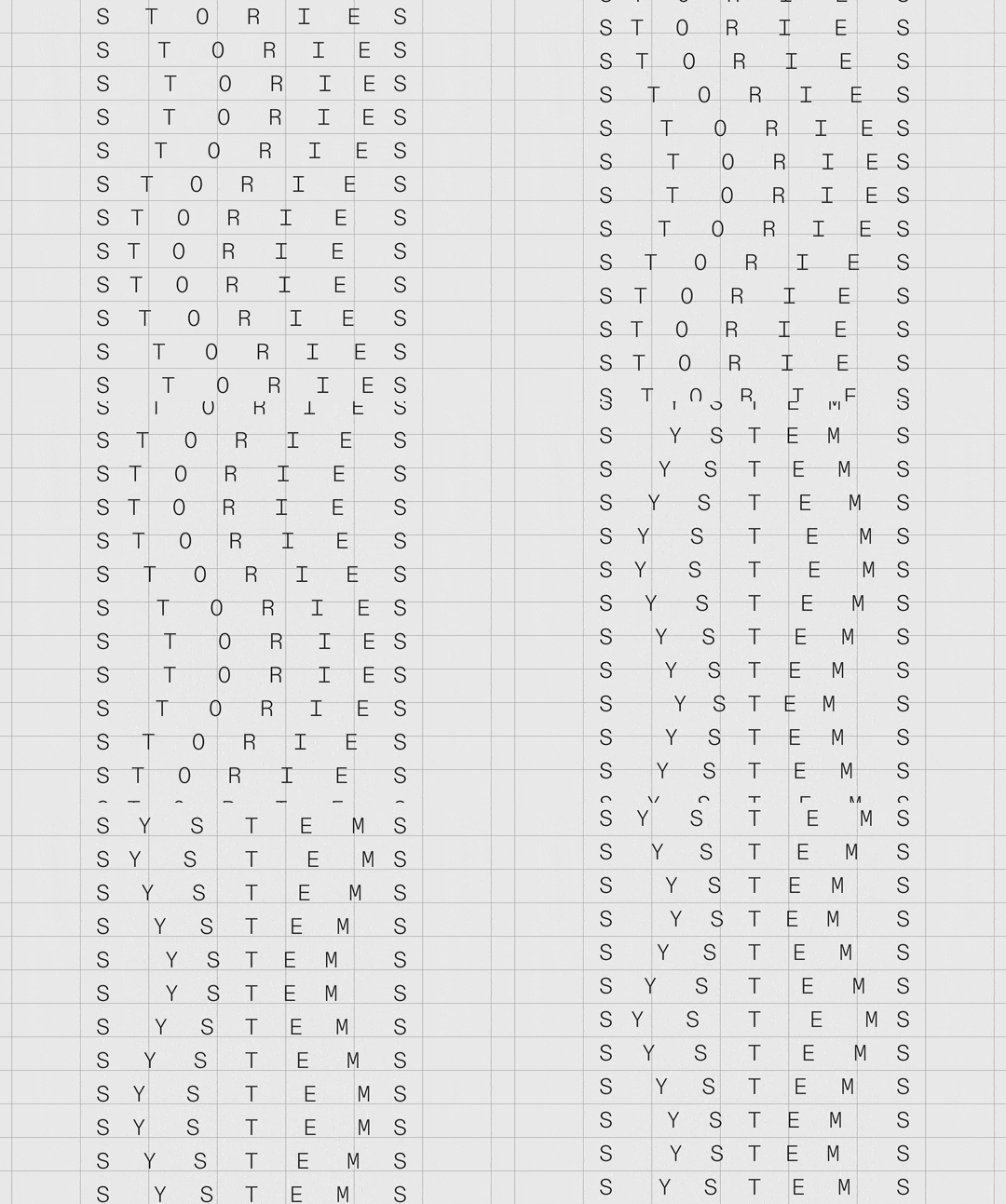
This was Ray Kroc’s legacy in action (RIP). Predictable satisfaction. His maniacal lust for order, systems, and protocols meant a post-Saturday morning sport-duty Dad could trust the crunch.
Sitting there, steering wheel in one hand, half-eaten hashy in the other, he squinted hard enough that he could see the beauty in Ray’s McDonald-obsessed world and the systems behind it. An iterative, repeatable, reliable masterpiece.
E-Myth is a bestseller for a reason. It’s an homage applying systems thinking to business and how to un-fuck yourself from the classic traps of running a business because you’re good at, or passionate about something:
Work on your business, not in your business. If you’re a slave to your business, you don’t have a business; you have a job :(
It’s calm, say less.
E-Myth TL;DR
Businesses are ecosystems. As the owner, you keep the plants from dying while creating and documenting processes, and ultimately making each facet reliable, predictable, and repeatable.
Slowly, you amass a WIP bible for running your specific ecosystem. You’ve found your secret sauce, but instead of it being your head, it’s documented. In fact, according to Ray, the secret sauce is its predictability, enabled by the systems. At this point, you can replace yourself, department by department. This is a big deal; most businesses never get here.
Thanks to the system, you no longer need 10x performers. Instead, you need go-getter systems-deprived disciples.
Eventually, you’re free of day-to-day operations. You can now double down on finessing the system. Ideating, implementing, reviewing and iterating. It never truly finishes, but that’s ok. System-as-a-culture is key. This doesn’t rule out innovation; in fact, the system allows for pragmatic cycles of strategy, prototyping, evaluation, iteration, and documentation.
So how about digital studios?
Can it work?
In fact, due to the creative problem-solving and scenario-based nature of studio work, without systems, teams will naturally adopt new approaches or techniques as needed.
That said, digital studios are businesses that serve people (much like restaurants), meaning there are many moving parts that can be made repeatable and predictable.
I’ve spotted evidence of digital studios attempting RAY's WAYS™. While reading a recent piece on working with clients, I was reminded of HAWRAF, a studio that generously published a treasure trove of behind-the-scenes processes as their parting gift when they closed up shop.
When the studio announced it was shutting down after only a few years in business, the four partners decided that their final act would be to live up to that initial idealism: They scrubbed their internal documents of client names and published them in a public Google Drive folder.
There was also Tom Sach’s 10 Bullets—a military-esque set of principles for fellow artists working in the studio to abide by.
Finally, one of the better examples is Gardener NYC’s Notion Resources, which is an open-source-like approach to ‘running a studio’.
I suspect all long-lasting studios keep their E-Myth strategies private, understandably. After all, how you work is often just as valuable as the work itself.

Some parting E-Myth gems
The system runs the business, the people run the system.
Create a ‘A systems-dependent business, not a people-dependent business.’
The difference between creativity and innovation is the difference between thinking about getting things done in the world and getting things done – Prof. Theodore Levitt